Wednesday, March 20, 2013

If you can't pronounce it, perhaps there is a translation...

"Sopa Seca de Arroz con Huevos."

  I  don't speak Spanish--it's kind of amusing when I try-- but I really enjoy trying.  Especially when I get to roll my "r"s or say "Huevos", which is a delightful word.   That, I do happen to know, is eggs; everything else I would have to guess at, find a friend, or use the internet.  Luckily for me, my recipe has a translation: Dry soup of rice with eggs.  That got my attention.  Dry Soup?  Well, it refers to the preparation.  How do you start a soup?  You throw everything in a pot, possibly pre-cooking it.  And that's how this is made-- you throw everything in a pan, and let it cook.  The difference between this and regular soup is that you use only as much broth as the rice can absorb, leaving you with the delicious (in a couple ways) oxymoron of dry soup.
I like this recipe for several other reasons, not the least of which was that it is fairly simple.  Look at the ingredients:  canned tomoatoes, frozen peas, carrots, onion-- nothing really out of the ordinary, except maybe the herbs, and you could probably skip those.  Simple ingredients also allow flexibility-- want to substitute?  The writer suggested using corn in place of peas.  Want to add?  How about some chilis, cheese, or even meat?  I also liked the premise under which it was published-- the Omaha World-Herald shared it with readers as an alternative to fish-sticks for meatless Fridays.  It's a vegetarian dish meant to be filling and satisfying, even to people who aren't willing to give up meat.

Ingredients:
 - 1 (14.5 oz) can diced tomatoes (I used Hunt's Fire-Roasted, for a little more flavor)
 - 1 Tbsp cooking oil
 - 3/4 C uncooked long-grain rice
 - 1/2 C chopped onion 
 - 1/3 C diced carrot
 - 2 or 3 cloves of garlic, minced
 - 1 1/2 C veggie broth 
 - 1/3 C frozen peas
 - 4 eggs 
 - 1 to 2 Tbsp chopped cilantro or parsley
 - Salt and Pepper to taste
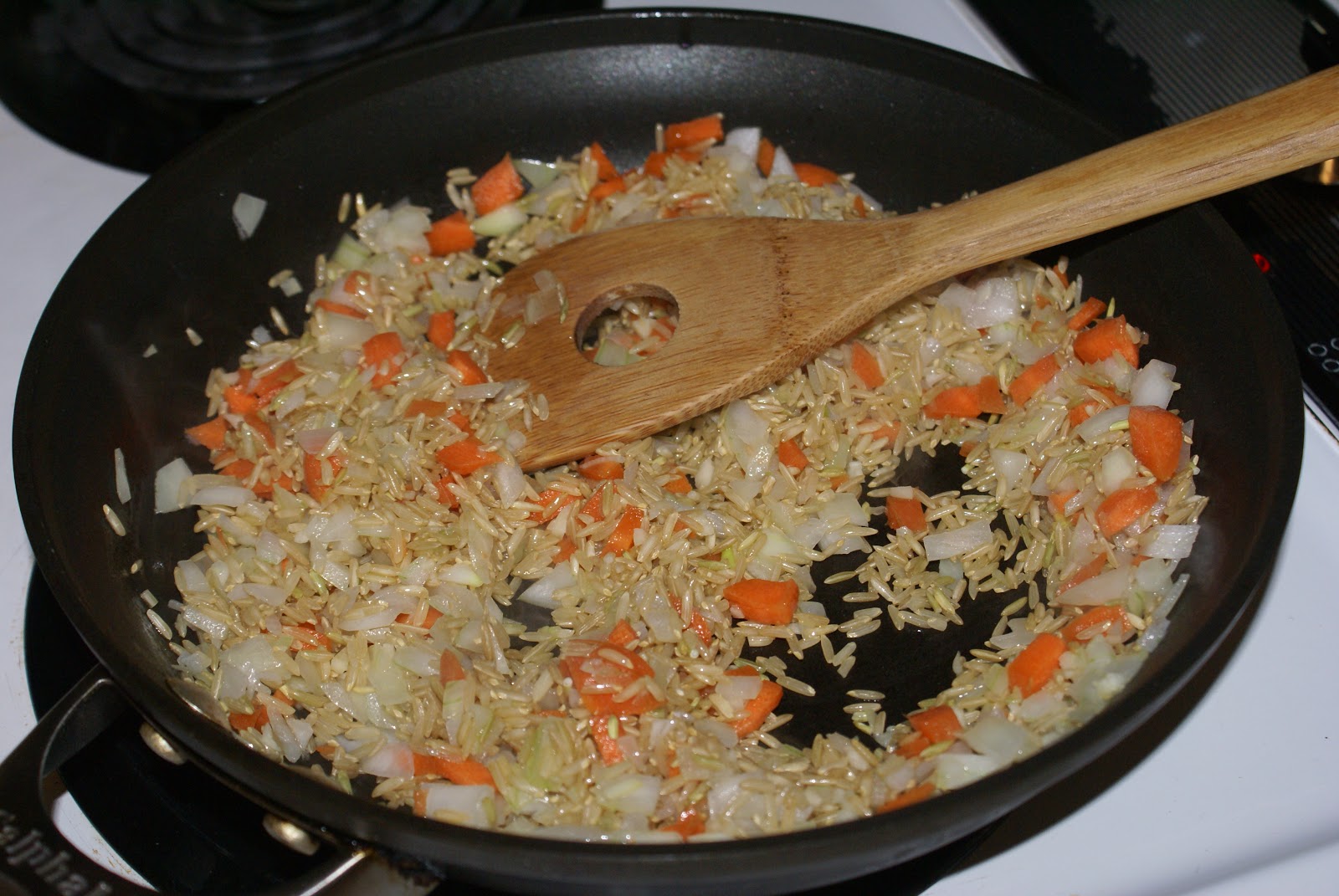
To begin, reserve about 1/2 C of the tomatoes for serving-- you'll cook with the juice and about 3/4 C of tomatoes.  Heat the oil over medium heat in a 10-inch non-stick skillet. (I don't imagine larger would be a problem, but smaller may be pushing it.)  To the oil, add the rice, onion, carrot, and garlic.   Allow to cook for about 4-6 minutes.  The onion should be softened, but the rice should not brown.  I used brown jasmine rice rather than an ordinary "long grain" rice.  This ended up increasing the time I needed to let everything simmer (next step) by about 10 minutes, but gave a fragrant/nutty flavor to the dish that I absolutely loved.

Add broth and tomatoes and juice that have not been set aside for serving.  Bring the whole thing to a boil, then reduce the heat, cover, and simmer for about 20 minutes.  At this point, the rice should be soft, although some of the liquid may still be unabsorbed.  Stir in the peas, then make 4 indentations in the rice.  (I checked the seasoning at this stage, because it seemed easier to stir before I put the eggs in.)  Crack 1 egg into each indentation.  Cover and cook until the egg whites are set, about 8-10 minutes.  I turned the heat back up, and probably would have given it less time, but I needed to make sure the yolk set, too, because I was cooking for someone who finds runny yolks extremely off-putting.


To serve, sprinkle with the parsley or cilantro.  I used parsely because I had some on hand.  Cilantro would have given slightly more flavor to the dish, but I didn't necessarily feel it was lacking in flavor.  Fun fact about the flavor of cilantro, by the way: I read a while back that research suggests how people percieve the taste of cilantro is genetic.  Some people love it; others think it tasted like dishsoap.  Usually taste is a matter of preference and conditioning (like peanut butter or vegemite), but in the case of cilantro, there seems to be a genetic link. Anyway, back to the soup-- pass the reserved tomatoes at the table.  The recipe also suggested serving with corn chips and guacamole.  I didn't have guacamole (this made me sad), and didn't feel like eating chips.  So, I cut a wheat tortilla into wedges, laid them out in my toaster oven, and broiled them for about 5-7 minutes until they were crisp and ever-so-slightly brown.  (See photo, above-left)  I placed those in the bowl prior to serving the soup, along the side.  I also put cheese and sour cream on the table, because my family loves dairy products.
One final note about this recipe: it serves four.  Perfectly, as far as I was concerned.  I fed it to three people, two of whom took seconds (smaller than a full serving), and we had just enough left over that I cooked it with an egg and called it an omelette.
My fully-dressed bowl of Sopa Seca de Arroz con Huevos.  Yum!


Thursday, March 7, 2013

Spinach Soup with Ginger

 I think I got this recipe from a book of potato-based recipes I saw while in Germany.  (It's definitely written in German).  Regardless, it's a pretty healthy Asian-inspired soup.  And it was pretty delicious.


 Ingredients:
2 Tbsp oil (recipe calls for sunflower, I used canola-- basically not olive)
1 Onion, chopped
2 cloves of garlic, finely chopped
1-inch piece of ginger, finely chopped (Photos, left, illustrate ginger chopping)
250 grams fresh spinach (about 1 package if you buy it in bags)
1 small stalk lemongrass, finely chopped
1 liter of broth (chicken or veggie)
1 small potato, peeled and chopped into small pieces
1 Tbsp Sake or Sherry
Salt and pepper
1 tsp sesame oil, to serve (optional, but recommended)

Chopping ginger can be a bit of a trick, because it has a woody texture.  My local paper recently ran a blurb about how best to chop it.  Start by peeling the ginger.  I like using a potato peeler for this; I find it takes off a thinner layer than if I use a knife.  (First photo)

Thinly slice the peeled ginger along the grain (not across the root), then slice the slices (still along the grain) into mini-French-fry pieces. (Second photo)

Up until now, I like to use a smaller knife.  At this point, I switch to my chef's knife, because I think it's easiest to chop by rocking that curved blade.  Chop across the grain, creating little minced ginger bits.  (Third photo)  I did have to pull the blade of my knife more than I normally would-- that's ginger.

In a large pot, heat the oil and sauté the onion, garlic, and ginger.  After 3 to 5 minutes,  the onion should be slightly transparent.  Add the lemon grass and spinach.   The spinach may over-fill your pot, so add it gradually if you need to.  As it cooks, you'll have more space.  Stir the hot onion mixture throughout the spinach (it'll help it wilt).  Stir until the spinach is completely wilted and clumps together.

Add the broth and chopped potato, and bring the soup to a boil.  Reduce the heat, cover the pot, and allow the soup to simmer for about 10 minutes.

Here's the part that's either fairly fun, or a pain in the butt.  You need to puree the soup.  If you have an immersion blender, you're golden.  Just stick in there, turn it on, don't tilt it and spray the whole kitchen.  If you don't have an immersion blender, you need to cool the soup so you don't crack your blender or food processor when you suddenly dump hot fluid in it.  (Done this.)  How do you quickly cool your soup?  Well, maximizing surface area is a great start.  In the photo, you can see that I've put it into 2 wide, shallow pans.  Also, when you're eating soup, you blow on it; moving the air across the surface allows heat to be more efficiently transferred.  So I set up a fan to blow on my pans of soup.  It doesn't need to be especially cool; as long as you can stick you finger in it without getting scalded, you're probably in good shape.

I used a food processor, but I think a blender would have been a better choice.  First and foremost, my food processor didn't hold liquids-- unless I used short burst, the soup spurted out.  This could be because it's from the 1980s, and not a problem with modern processors.  Or it could be because food processors aren't really made for liquids.  Blenders are: they have lids that seal in their contents.    I think if I made this again, I would certainly use a blender.  I think that would solve my biggest texture problem: the lemon grass.  Lemon grass is sturdy stuff.  It didn't puree well in my processor; I think if I had left it to run for more than 1 second at a time, that wouldn't have been a problem.  As I said before, though, that would have resulted in soup all over my counter.

Return the pureed soup to the pot (if necessary) and re-heat it.  Add the sake or sherry and season to taste with salt and pepper.  I also threw in some Oyster Sauce (used in Thai cooking) because I happened to have it in the fridge and am trying to use it up.  It gave a bit more umami flavor, sort of rounding out the taste.


Serve the soup with a bit of sesame oil on top.  You don't, strictly speaking, need it, but it gives a different flavor.  Sesame oil is potent, so just a couple drops are sufficient.  You could also probably achieve a similar flavor using sesame seeds, but that wouldn't be quite as strong, and it would alter the overall texture.  The recipe also suggested garnishing with strips of spinach leaf-- just thinly slice a couple leaves, and sprinkle them on top.  I didn't do this, as you can see.  The other thing to note-- those bowls are all the soup I made.  The recipe said 4 servings; I was able to get 5 of just the right amount.  I served with toasted baguette on the side.

White Sauce

I think of white sauce as more of a technique than a recipe, and I get A LOT of milage out of it.  I discovered the roux-based sauce while reading Cooking for Geeks, by Jeff Potter (I highly recommend this book to anyone interested in food science or learning to cook-- ISBN 9780596805883).  He includes a recipe from Béchamel Sauce and a couple different variations.  And that got me started.  Using this technique, you can make everything from gravy to alfredo sauce.  (One of my favorite things to do with it is beer-cheese sauce, but that'll be another day.)

 To make the Roux, melt butter in a saucepan, then add roughly the same volume of flour (usually you see 1-2 Tbsp of each-- more for more a larger recipe, obviously.)  Let the flour/butter mixture brown a bit for optimum flavor.  Be aware, though, there's a trade-off involved: Browning the flour reduces its thickening power.

After a couple minutes, start slowly adding milk or cream.  What does "slowly" mean?  Add a bit of milk/cream (or broth, even, but you want a fatty broth-- the fats interact with the flour to thicken the sauce), then stir like crazy until the texture becomes uniform. Otherwise, you wind up with lumps, and it doesn't thicken as effectively.  Not the end of the world, but not ideal.  In the photo above, the mixture is almost ready to have more milk added.  (See how there's still a bit of unincorporated milk at the edges?)

Continue gradually adding liquid until the sauce becomes liquid-y.  You can then add in bulk until you have the desired volume of sauce.  [Potter's recipe calls for only 1 cup of milk to be added to a roux made with 1 Tbsp each of butter and flour; using cream allows more liquid to be added.]  If it seems a bit thin, don't freak out.  Allow the sauce to gently simmer (stirring constantly to avoid burning) until it thickens.  This is also the time to season your sauce!  Add salt, pepper, cheese, herbs...  here's where you define and differentiate your white sauces. The sauce pictured here was flavored with Lowry's seasoning salt, fresh basil, and black pepper.  White sauce is also great when flavored with mustard (with or without cheese).

Sunday, March 3, 2013

"Aubergine" is British for "Eggplant"

Recently, I was just poking through the cheeses in the deli section of the grocery store (that's where they keep the fancy stuff, like imported Asiago or a family-owned diary's specialty chipotle cheddar, so it's more interesting than you might think), I came across Halloumi cheese.  It's a kind of Greek sheep's milk cheese; the label describes it as, "the grilling cheese of Cypress".  I got really excited, because I had seen it in one of our cookbooks, and wound up buying it.  I still haven't done anything with it, because I got distracted.  By eggplant.


Right now I'm focusing on vegetarian meals (although I'll also eat fish) because of Lent.  The problem with vegetarian food is that most of us are used to eating veggies as a salad, on the side as a not-so-exciting accompaniment, or in meat-based dishes (like my stir-fry).  So when I came across a recipe for Italian "Grilled Aubergine Parcels," I got excited.  Here was a new and different way to eat my veggies!  Basically, it's eggplant wrapped around cheese and tomatoes.  If you like those three things, keep reading.  

The recipe comes from Mediterranean: A Taste of the Sun in Over 150 Recipes, by Clark and Farrow (ISBN 9781843090151, if you're dying to know).  It's a pretty good cookbook, actually, featuring recipes from the entire region (from Turkey to France, including Morocco), so it appeals to a variety of tastes.  It's beautifully illustrated and each recipe is well-presented and easy to follow.  The only complaint I have is that it was written for a British audience.  There's nothing wrong with that, really, except you sometimes come across things that are confusing.  Like, what is gammon?  It's either hamsteak or bacon.  (Thank you, google.)

Aubergines are eggplants.  To make Aubergine parcels, you need 2 large, long eggplants, 2 tomatoes, 8 fresh basil leaves, and 8 oz. mozzarella.  Begin by thinly slicing the eggplants lengthwise into ~1/4 inch slices.  This is the tricky part.  If you have a mandolin (that's like a home version of a deli-slicer), you're golden and laughing at all of us who don't (guess which kitchen gadget I want).  If you don't, take a long, sharp knife and slice very carefully, paying attention to both ends of the blade to make sure 1) that you are cutting evenly, and 2) that you are not about to slice off your fingers (past experience).  Some people like to slice parallel to the board; this rarely works well for me.  I had the best luck standing the eggplant on its end (where I had chopped off the stem) and slicing down toward the board.  You want to wind up with 16 slices, not counting the edge slices with the skin-- that comes down to 10 slices per eggplant.  

Once you have successfully sliced your eggplant, toss the slices in salted, boiling water for a couple minutes until they are easily bent.  Let them drain on a rack, and/or blot them with paper towels.  


Remember those tomatoes?  Slice them into 8 slices.  Do that with the cheese, too, but try to make your cheese slices similar in size to the tomato slices.  To assemble your "parcels", take 2 slices of eggplant and arrange them  as a cross.  Season them with salt and pepper, and layer 1 tomato slice, 1 basil leaf, and 1 slice of mozzarella.  Season again, then fold the ends of the eggplant up around the stack to make a neat little bundle.  I had to use toothpicks to hold everything in place.


Place the parcels (there should be 8, if you haven't been following the math) in the refrigerator for about 20 minutes.  When they are cool, brush them with Olive oil and grill them over direct heat for about 5 minutes a side.


A brief note about my family's preferred grill set-up.  We have a  propane-fired grill.  This allows us a little more temperature control.  The draw-back is that we don't get those wonderful flavors that come from charcoal.  To compensate, we almost always cook with wood chips on the rack next to the food.  The flame from our burners scorches the wood and causes it to smoke.  We close the top of the grill, and the smoke flavors are absorbed by the food.  For a recipe like this, the smoke-flavor isn't a big deal. For a steak or something that cooks longer, you notice it more.  A note of caution:  don't run out and grab the first wood chips you find.  You want to make sure they haven't been treated with chemicals that you really don't want to eat.  Look for wood chips in the grilling section of the store (we have applewood and hickory chips marketed by CharBroil) to make sure you're getting edible ones.


To top the aubergine parcels, combine 4 Tbsp olive oil, 1 tsp balsamic vinegar, 1 Tbsp tomato paste, and 1 Tbsp lemon juice to make a dressing.  Vinaigrettes are that easy to make-- basically 4 parts oil for 1 part sour stuff.  You can get creative from there.  I used tomato paste that had some pesto seasoning (basil) in it to give the dressing a bit more pop.  Taste, adjust, and add salt or pepper if you think it is needed.


To go with the parcels, I had bought some bread.  When I wound up with a bunch of extra tomato and eggplant, I decided to make a Bruschetta.  Traditionally, bruschetta is grilled bread rubbed with garlic and topped with oil, vinegar, salt and pepper (doesn't that sound like a salad dressing?).  Most people (at least in the US) think of it as having tomatoes on top.  My variation had no garlic.  I just chopped up the leftover tomato and eggplant, spread it over the bread, added salt and pepper, and drizzled over olive oil and balsamic vinegar.  I stuck it under the broiler until the edges of the bread were browned.

I served both the parcels and the bruschetta topped with the vinaigrette and pine nuts.

Friday, February 22, 2013

My first risotto!

I enjoy watching cooking shows (are you really surprised?), and I've noticed risotto comes up with some frequency.  But, until I made it myself a few days ago, I had never eaten risotto myself.  I think that's part of the reason I had it set up in my mind as a challenging dish.  That, and you NEED arborio rice.  According to wikipedia (I started my search for what, exactly, risotto is supposed to be there), you can use some other types of rice, but they're difficult to come by, and arborio gives satisfactory results anyway.


Risotto recipes are easy to find-- google it, or open an italian cookbook (not all will have risotto, but many do).  Even the bag of rice I bought had a basic risotto recipe printed on it.  Generally, a risotto is made by sautéing some onions, toasting the rice, adding some wine, then gradually adding hot broth while stirring, stirring, and stirring.  The stirring is key, and my copy of Modernist Cuisine at Home (I freely admit to name-dropping) tells us why: what makes risotto so wonderfully creamy is starch.  Arborio rice (and others suitable for risotto) are especially high in amylopectin, a type of starch.  Amylopectin is the branched starch that
your body easily breaks down (think of the starch molecule as a stick you 10 other people want to break into toothpicks.  The more branches it has, the more places there are for you to grab on and start breaking.)  The problem is that starch is kept inside the cell (you know, where the plant can use it).  When you expose the rice to hot liquids, some of the starch can be released, but the majority of it is released by mechanically whacking those cell walls--by stirring.  So the more you stir, the more cells walls are broken, and the more walls are broken, the more starch you set free, and the creamier your risotto becomes.

I used another recipe from Rachael Ray's Big Orange Book, mostly because I had wanted to try it for a long time, but also because I had leftover beets hanging out in my kitchen: Beet Risotto.

1) Heat an oven to 400 degrees (Fahrenheit).  Place 4 medium beets, scrubbed and with the ends trimmed, on a large piece of aluminum foil.  Drizzle oil over the beets, and season with salt and pepper. Fold up the foil and place it in the oven, roasting the beets for about 45 minutes until they are tender.  (You could also do this on a grill, if you prefer, or even a campfire, though I don't know why you would.  It just occurred to me that I've cooked veggies over a fire this way before.)  Once the beets are soft, let them cool, then throw them in the food processor/ blender and puree them.  Do be careful.  It will stain.

2) In the meantime, heat up 4 cups vegetable stock with 2 cups of water added-- bring it to a boil, then just keep it warm.

Toasting the rice.   Note: this pan was NOT big enough to finish the recipe.
3) Sauté 1 chopped onion and 2 minced cloves of garlic in 2 Tbsp oil and 1 Tbsp butter (I imagine the butter is for flavor-- I certainly love the flavor it gives!) in a LARGE saucepan over medium-high heat.  When the onion is tender (I went until it was slightly caramelized), add 2 cups arborio rice, and toast it while stirring for about 2 minutes.  Add 1/2 cup dry white wine, and cook about 1 minute until the liquid has been absorbed.  Now start adding the hot stock, a ladle or 2 at a time, stirring constantly and vigorously until each addition has been absorbed.  When you're done with the stock, add the beat puree and season with salt and pepper.  The risotto should be creamy, but the rice should also still have a firm texture.  The recipe says it's shouldn't take much more than 18 minutes. (Mine took a bit longer, but not much.)  Stir in 1/2 cup Parmigiano-Reggiano, and check flavors again.

4) Serve topped with extra Parmigiano and/or feta.  Rachael Ray serves it over the greens from the beets, but my beets were old and didn't have nice greens.  I would have used spinach, if I had some, or possibly kale, which I've never eaten but would look pretty. (dark red, dark green...)

Rachael says it makes 4 servings.  My family of 5 was given about half of what was made, and thought it was an awful lot.

Tuesday, February 19, 2013

Some Abstract Musings... And Easy Veggie Soup

Due to the fact that I ran an 8-mile race yesterday, I didn't plan anything really blog-worthy.  I just made soup.  We'll get to that in a moment.  But I wanted to talk about recipes in general first.

My mom accused me of being close to having more recipes than I could possibly make.  She may be right. (Let's hope not.)  But it raised an interesting question in my mind.  Is the sole purpose of a recipe to tell us how to make a dish?  I don't think so.  In fact, I have some recipes I'm pretty sure I'll never make, such as a recipe for pork cake.  (Because breakfast should be a meaty, coffee-containing fruitcake.)  It's from a cookbook published in the 1920s, and shares a page with recipes I actually would eat.  But more to the point, I think it's interesting.  It tells me a bit more about what people were eating and how they were cooking a little less than a century ago.  This same cookbook also has a section of tips for stain removing, pain relieving, etc. and a chart for converting cooking using a wood-fired stove/oven to cooking using a swanky new gas-burning one.  Nifty, right?


Even if you don't care for the historical or cultural insights recipes may provide, they can also provide more practical information beyond making pork cake for breakfast.  From that recipe, I might choose to pair coffee and pork together in a recipe of my own devising (perhaps a coffee marinade?), or any of the other ingredients.  A recipe may also have a novel cooking approach (bagels, for example, are boiled prior to baking, which gives them their chewy texture; would I have thought of that?  Can I use it for something else?)  Perhaps a recipe features an ingredient you don't care for-- can you alter it to create something you'll love?  Maybe a recipe just gives you an "aha!" moment, and your mind runs to something new and wonderful.  (My first encounter with puff pastry was a recipe I didn't bother to save, but I've had some great times with puff pastry since then.)

Now, the soup:

Soup doesn't have to be ridiculously simple, but it can be.  Which is one of the great things about it.  Other great things: you can use even more things in soup that you can in stir-fry (I'm trying to think of something I can't use in soup... well, I guess cookies, etc. would be stretching things), soup is multi-cultural, soup is homey.  It can be a hearty meal to itself, or it can be a light starter.

Easy Veggie Soup-- Throw everything in a pot (or slow-cooker) with water.  Simmer until you are ready to eat it.


In slightly more detail-- I chopped some onions, minced some garlic, and sautéed those.  While doing that, I chopped up some carrots, celery, and broccoli.  Those got added along with frozen corn, canned beans, and canned tomatoes.  The tomatoes are my favorite thing to add to veggie soup.  Don't bother to drain the canned items.  Add water, and noodles if you like (I used Ditalini).  Season to taste with salt, pepper, herbs, and/or spices.  I used Italian seasoning, a bay leaf, tabasco sauce, pepper, and Lowry's seasoned salt (as well as regular salt).  I also added some sweet vermouth to give the flavor more depth.

Tuesday, February 12, 2013

Saucy Stir-Fry

One of my favorite things to make is stir-fry.  It's quick, it's easy, it uses whatever you have in the kitchen (within reason)... What's not to love?  So here's a variation I came up that uses peanut butter and orange marmalade to create a rich, flavorful sauce.  My roommate said it reminded her a bit of orange chicken.

A quick note before we get started.  I am terrible about measuring things (unless I'm baking).  It's funny, because people like that really used to drive me nuts (How do you know how much to add?)  In an effort to avoid those frustrations, I'm putting down approximations.  Adjust them according to taste-- they're pretty flexible.  Also, this particular write-up should easily serve 6 people.

Meet the Cast!
I use chicken breasts for this recipe, and an assortment of veggies.  Onion, carrot and celery are my favorites-- I usually have them in the house because they're useful for all sorts of things!  I used about 4 carrots (cut them into 3/4 inch chunks) and 3 celery sticks (roughly chopped), and probably about 1 1/4 cups of onion (measured after being chopped).  I had 3 large chicken breasts tonight, and cut them across the grain (the short way) into 1/2 inch-thick strips.  I also had 2 large mushrooms which I halved and sliced.

In a large pan (or wok), saute onions and 2 Tbsp minced garlic in oil until the onions are transparent (maybe 5 minutes over medium-high heat), then add the chicken.  Stir-fry until the chicken is no longer pink. (Because there will be further cooking, you can get away with color change observation rather than temperature-checking.)

Add the carrots next, because they are the most heat-tolerant.  Use this time to prep your sauce. 

 It's not going to be the most beautiful thing you've ever laid eyes on-- you're combining things that, due to their chemical make-up, aren't going to mix.  Combine about 3/4 cup of peanut butter (chunky or smooth-- it doesn't matter), 1 cup orange marmalade, 1/2 cup soy sauce, and pepper to taste.  You can also add 1 tsp fish sauce if you have it to give the sauce a little more umami flavor (often described as meatiness).  If you don't have fish sauce, it really isn't necessary. Feel free also to add 2 tsp ground ginger if you have it.
The carrots have now been in the pan for a minute or two, so go ahead and add the celery, then the mushrooms.  (Just keep stirring everything-- there's a reason it's called stir-fry.) If you like, add 1 cup cashews or peanuts, too.  Add the sauce, and let it simmer and thicken.  TASTE TEST IT.  If you want more of a certain flavor, add it.  This would also be the point, if you wanted, to add frozen veggies (I wanted to add green beans, but we were out).


As soon as your sauce has thickened to the consistency you want, you're good to serve.  You can expedite the thickening by adding corn starch dissolved in a bit of cold water.  (Don't skip the dissolving step, or you get this horrible gritty texture.)  You can eat this on its own, if you like, but I prefer it served with rice.